

Other counties get that Plan B is a problem. WCPS needs to change course before it’s too late.
If you have been following the Wayne County Board of Education’s recent decision to begin the school year on the state’s hybrid Plan B, you also are aware that the 5-2 vote has caused a bit of unrest among teachers, staff and the community.
And if you have been keeping an eye on Facebook comments and messages and actions by board members who voted on the “yes” side, you know that the board does not seem all that interested in changing its plans for the first days of school.
In fact, some members are doubling down — and getting some backup from a newly created Wayne County Republican Party Instagram page, which includes a post justifying the decision with the latest CDC guidelines.
At today’s special called board meeting — we will have much more on that later — board member Ven Faulk asked that a link to the CDC report be posted on the Wayne County Public Schools website.
He, and the county GOP, failed to mention that CDC director Robert Redfield said after the guidelines were published that there should be exceptions for states in the “red zone.” (North Carolina is in the red zone, which is defined as a state that is reporting more than 100 cases per 100,000 residents a day.)
So, while we can’t tell you what the board’s next move will be, we suspect that the recent flurry of district-produced meeting summaries and announcements might signal a new strategy — controlling the narrative.
Can’t imagine who forced that move. But in case you need a hint, we should point out that the New Old North is not exactly on the district or board’s speed dial list these days.
In fact, we are still waiting for an interview we requested two weeks ago about the district’s reopening plan.
And we will keep waiting, because we have heard from numerous parents who didn’t even know how to find the registration form for the Virtual Academy.
And we know that there is no way every family has the information they need to make an informed decision.
With less than three weeks until classes start, the district’s “plan” is still in draft form. And there is no telling what the Virtual Academy will look like, again, because the district refuses to detail this critical information beyond self-published “news” stories on a district website that doesn’t get much traffic.
Think about it this way. When WCPS was talking about closing Edgewood, they couldn’t get in touch with all the parents. And those particular families were heavily vested in that decision.
Have you gotten a call from your child’s principal about Plan B vs. Virtual Academy? Have you gotten a call from a member of the Central Office team?
Your phone was ringing off the hook when WCPS wanted to inform you about food distribution locations when schools were closed this spring, but what about now? How many calls have you gotten about the deadline for making this monumental decision?
And even if there were robocall reminders, keep in mind that during the Edgewood debacle, WCPS staff noted that many phone numbers for families that were on file were incorrect. So, it seems hard to believe that every family’s decision-maker is even aware that they have a choice between remote instruction and face-to-face learning.
At this point, the lack of information is more problematic than the virus.
And the scary part is, it doesn’t stop at families’ decisions on how their child will be educated this fall.
It’s proof positive that WCPS is not ready to send children back into schools.
We know that because there is another piece of information that came across the news this past week. Most school districts in North Carolina have chosen to start the school year, at least for the first few weeks, in Plan C, the remote learning option.
And that includes the conservative-leaning Johnston County school board and most recently, nearby Duplin and Lenoir.
Why the delay, you might ask. If the goal is to get children back in the classrooms, then shouldn’t we get on with it?
The point that these boards seem to get — and the one WCPS’ seems to have missed — is that waiting a few weeks does nothing except make the school experience better for teachers, students and staff.
A delay brings with it the opportunity for ALL families to weigh in and for ALL the information to get out.
So, we ask the question: Are Wayne County Public Schools ready to welcome students back safely?
We get why the board might be sticking to its guns on this position.
There is a reason so many people are doubting the motives of those tasked with directing the COVID-19 pandemic response.
There have been conflicting reports, mixed messages, battling experts, test results controversies and a whole lot of coverage that smells more like advocacy than unbiased reporting.
They say it is all about science, but is it? Some people aren’t so sure anymore.
But no matter where you stand on COVID-19, there is something we all agree on. No matter how much we might argue about what we have gone through over the past four months — and whether that response was justified or an overreaction — the bottom line is we want our students, teachers, bus drivers, custodians and cafeteria workers to be safe.
And to do that, caution is a necessity. And, again, people need to understand all the information — mainly, what school is going to look like under Plan B.
So, while we might want to get those school doors back open and students and teachers back to their desks — for what it’s worth, that is what we want, too — we know that there are concerns to overcome.
And we know that because the professionals we have tasked with getting those doors open have pointed out the many details that have to be worked out.
And that is why Johnston County, which has a detailed — yes, we said DETAILED — plan for returning under Plan B ready to go, decided not to bring back students until after Labor Day. That decision, by the way, was made after a six-hour meeting where district staff had answers for nearly every concern raised by board members.
The board wanted to give the schools time to make sure that they have worked out the kinks and to give scientists and others a little more time to come up with more reliable therapeutics and possibly get a little closer to a vaccine.
That is because they know that schools have a tendency to be petri dishes anyway — that it is difficult to keep illness from spreading through the hallways and that keeping children apart, at any age, but especially in elementary school, is beyond a challenge.
But whenever we talk about why there should be a delay, we get hit with “all you do is criticize, but you don’t offer a solution.”
So, we have decided to do both.
Let’s start with the purpose of a hybrid plan.
The idea is to get children back in school, right?
But what will that mean exactly?
We did the math.
The hybrid model requires teachers to manage not only in-person classes at school, but remote learning students as well. That means their day will have to be divided — and that necessitates shorter class periods and early dismissal for the “in-person” learners.
Assistant Superintendent for Teaching and Learning Tamara Berman-Ishee told the board as much before the vote.
So how much time will students actually be in the classroom?
Under the Plan B model, high school students would get face-to-face instruction four days every three weeks. There are 18 weeks in a semester and, by the way, there is zero chance Gov. Roy Cooper reverses course ahead of November’s election. That means if Plan B sticks through Christmas Break, high school students will net 24 days of in-person instruction.
Now, what if the district justifiably honors the need for early dismissal? Those “days” begin to decrease.
UPDATE: In a message sent to families through Class Dojo — a message that was screen-shotted and is now making the rounds on social media — Northeast Elementary School Principal Julie West confirmed students would be dismissed at 1:15 p.m. We have reached out to WCPS for comment and will update this story if/when a response is given.
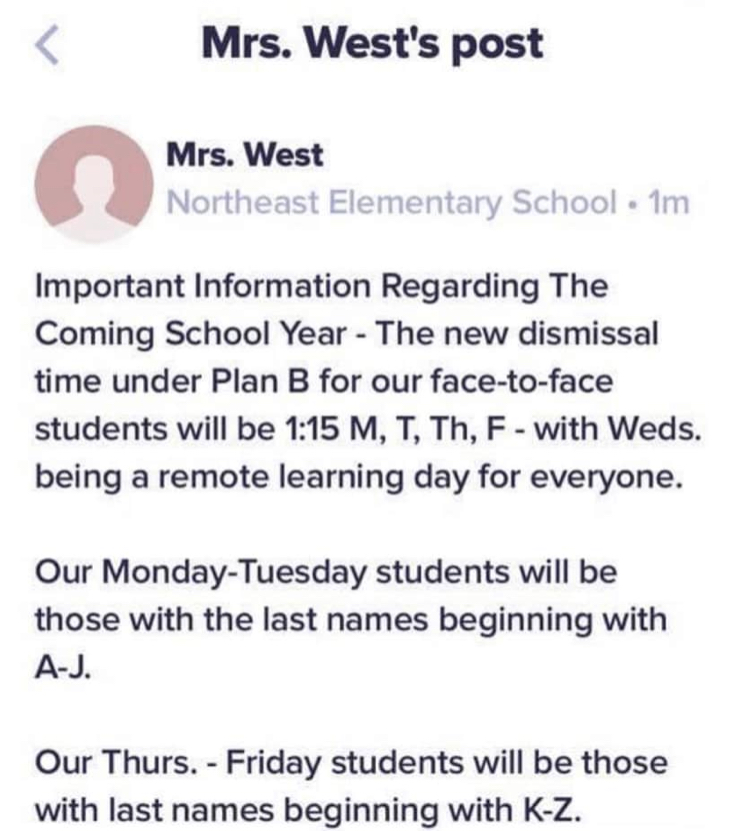
Throw in temperature checks, eating in classrooms, sanitation protocols if someone at school is sick and those hours decrease even more.
The same is true for K-8 students. Under Plan B, they would attend school for two days a week for 18 weeks. That’s 36 days. Between now and Christmas. Again, early dismissal and the aforementioned checklist requirements would make that number smaller.
Does that seem like game-changing instructional time?
And the hybrid Plan B does not eliminate one of the most-pressing problems — what do working-parents do with their children when they are not in school?
We have had many of them tell us that Plan B solves nothing. They still need more daycare and have to manage remote learning themselves for the vast majority of first semester.
Think about this: If you work a fulltime job and your child is K-8, you are still in a bind for three days a week. High school parents are only covered four days every three weeks.
Where are all these children going to go?
And who is going to pick them up on the days they are actually in school but are dismissed early?
The district is trying to come up with alternatives, but how is that going to work?
Is stuffing kids in daycare, afterschool programs or on-site classrooms any better than returning to school?
Sure doesn’t sound like it to us.
And that brings up another issue — another of the reasons board members gave for supporting Plan B — socialization.
Our kids need to be with their friends, and there are consequences from the isolation and the circumstances they have faced in the last four months. That goes without saying.
But what will happen when they get back to school?
Their classes will be smaller — and there is no guarantee that they will be in a room with their friends.
They must wear masks. They must social distance.
That means no shared giggles or whispers in the hallways and no lunch table conversations.
And what about recess — or art class, chorus or gym?
They won’t look anything like they did pre-COVID.
That is not socialization.
Not unless teachers and administrators blatantly violate the state’s mandatory protocols.
OK, so those are the challenges. What is the solution?
Start remotely — like Johnston County.
And like Duplin and Wilson counties.
And like Wake and Durham counties.
And like Sampson, Cumberland and Lenoir counties.
Take the time to get the kinks worked out, to try options and to make sure the supplies, the plans — and the internet accessibility necessary for this to work — are in place.
Set a hard date and give parents and the community time to come up with safe ways to make sure their children get to school and can actually learn there.
We can all pretend that remote learning was seamless, but it wasn’t. And those issues need to be addressed as well.
If students are set to come back in September, the district will have the time it needs to make sure the needs of the students — and it really is about the students — are met, and teachers and their families are protected as well.
We know we cannot hide from COVID-19 forever. And we are optimistic that soon we will be back to where we were four months ago — a little more cautious and still taking care to respect the health consequences of the pandemic, but more comfortable that we can run a school and a classroom safely.
All this would be is a delay — a little more time for families and schools to get their affairs in order.
Teachers and principals will work together to get their students’ school years started, and while it might not be the best way, it will be the responsible and practical way.
Families could get a better handle on how to manage early dismissal days and work with local daycares to ensure their children have a place to go on those many days they will be out of school.
So, here is the motion that we should hear this Monday at the board’s regular monthly meeting: Start school Aug. 17 remotely for all students. Pick a day during the week after Labor Day as the first official hybrid day or later if that is what is best, with an eye to returning to regular classes as soon as possible.
That “back to normal” date might be dependent on a vaccine or more research on effective therapeutics — or numbers that suggest we are where we need to be.
There will still be doubters and those who aren’t sure you are doing the right thing.
There will be those who think the delay is an overreaction and those who will label it an underreaction.
But you will show that you understand the fears and challenges — and that this is about listening and being flexible.
And if you don’t, be upfront with parents and students about what in-person instruction is going to look like.
Ensure every single one of them receives a phone call or a letter from the district.
Tell them that children won’t be able to share playground equipment or hang all over their friends in the hallways or classrooms.
Tell them that high-schoolers will only be on campus 20 times between now and Christmas — and that K-8 students will only be there 36.
Admit that what Berman-Ishee explained was true and those 24-36 days on campus will be early-dismissal days and that recess, gym class and electives are either not going to happen or are going to lose all value when you factor in mandatory social distancing and mask-wearing.
And be real with the teachers you serve about the challenges they will be forced to meet as both in-person and remote educators.
Because if you believe every WCPS teacher is going to be live-streaming lectures from their classrooms, you are fooling yourselves. It is simply not a realistic expectation given the resources available to our educators.
Just don’t make the decision to be the rogue county to prove a point about how you think the coronavirus pandemic has been managed.
This should not be about politics. Not now.
There are plenty of questions to be asked about all of this and we should ask them later.
Right now, this should be about what the best course of action is to keep our community safe.
The reason other counties are waiting is because under the governor’s directive — which, by the way, was a non-decision we think was designed to protect his political interests and appease his base ahead of the election — more planning and a cautious start is the more prudent option.
Wayne County should follow suit.



A loaded discussion

Fighting for their lives


Goldsboro loses a giant

“I’m a flippin’ hurricane!”
Public Notices — March 29, 2026

Belting it out
Legendary
In her Nana’s image